
Expanding I/O Capabilities with the Microchip MCP23008 I2C GPIO Expander
In embedded system design, a common challenge is the rapid depletion of available General-Purpose Input/Output (GPIO) pins on a microcontroller (MCU). As projects increase in complexity—integrating more sensors, displays, LEDs, and buttons—the limited number of I/O ports can become a significant constraint. The Microchip MCP23008 provides an elegant and efficient solution to this problem, serving as an I²C-based GPIO expander that adds eight additional digital I/O pins using just two wires from the host MCU.
The core functionality of the MCP23008 revolves around the I²C serial protocol, a widely adopted two-wire interface comprising Serial Data (SDA) and Serial Clock (SCL) lines. This allows the chip to communicate with the MCU at speeds up to 1.7 MHz, facilitating rapid reading and writing of its I/O ports. Each of the eight GPIO pins can be individually configured as either an input or an output through the I/O Direction (IODIR) register. Furthermore, the internal pull-up resistors can be enabled for any input pin via the GPPU register, eliminating the need for external resistors when connecting switches or buttons.
A significant advantage of the MCP23008 is its interrupt capability. It can generate an interrupt signal on an open-drain output pin (INTA) based on configurable conditions, such as a change of state on any input pin. This allows the host MCU to operate efficiently without continuously polling the expander, saving processing power and reducing overall power consumption. The interrupt is accompanied by dedicated registers (INTF and INTCAP) that identify the pin that caused the interrupt and capture its state at the time of the interrupt, respectively.
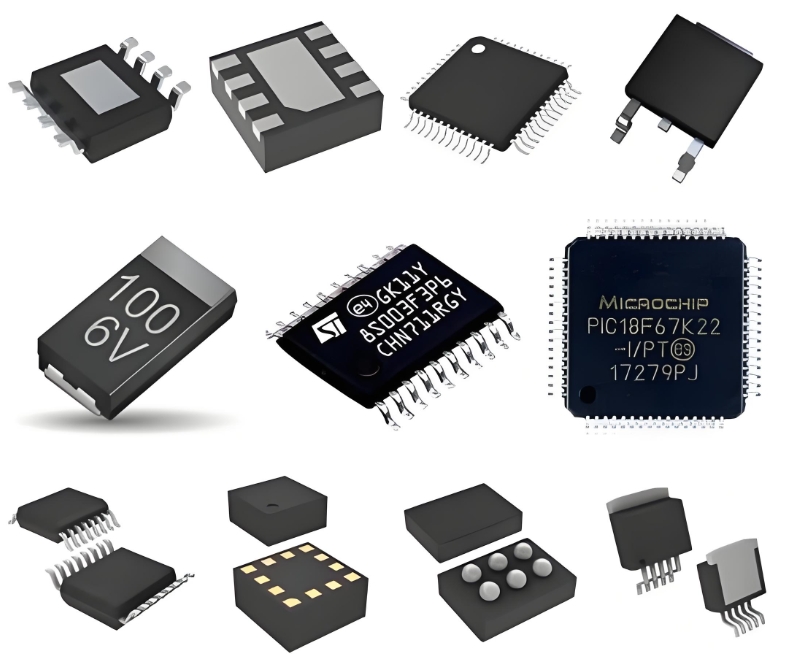
The process of integrating the MCP23008 is straightforward. After connecting power (2.7V-5.5V), ground, and the I²C bus lines, the chip's address is set using three hardware address pins (A0, A1, A2), allowing up to eight such devices to coexist on the same I²C bus—potentially adding 64 I/O pins with minimal wiring. Software control is achieved by reading from and writing to the chip's internal control registers, a process managed through simple I²C transactions.
Typical applications for the MCP23008 are vast, including industrial control systems, where it can monitor multiple digital sensors; consumer electronics, for keypad scanning; and smart home devices, to control an array of LEDs or read multiple toggle switches. Its ability to operate at 5V and 3.3V levels makes it compatible with a vast majority of modern MCUs.
In conclusion, the MCP23008 I²C GPIO expander is an indispensable component for overcoming I/O limitations in embedded designs. Its combination of simple serial interface, flexible configuration, interrupt functionality, and daisy-chaining capability makes it a superior choice for efficiently scaling the I/O capacity of any microcontroller-based project.
ICGOODFIND: The MCP23008 stands out as a highly versatile and cost-effective solution for GPIO expansion, perfectly balancing ease of use with powerful features like hardware interrupts and internal pull-ups, making it a top recommendation for developers.
Keywords: GPIO Expander, I²C Protocol, Microcontroller Interfacing, Embedded Systems, Input/Output Expansion.

